Why Did Natives Do Head Binding to Babies
Beauty is a fickle affair. Worse than that, it is (equally ofttimes as not) 1 of the nigh painful goals in the realms of the wealthy and elite. In People's republic of china, the binding of feet was once seen to create beautiful, dainty extremities. To those in western civilisation, this is often viewed every bit a torturous activity. The Yoruba tribes of Nigeria, Republic of benin, and Togo in Africa practice scarification: the cutting or burning of skin to create representations of familial ties. Once over again, much of modern western culture would view this as a terrible childhood practice. Still people with this perception do not realize that similar practices were performed not just in recent times, merely in their own backyard. In North America ane of the near prominent examples of painful adornment was the tradition of caput-binding among the people of the Chinookan tribe in the Pacific Northwest.
Binding Children's Heads to Show Nurturing and Status
In the Chinookan tribe, head binding (also known as artificial cranial deformation) occurred when an elite child, male person or female, was first born, and it was the responsibleness of the parents to ensure this do was followed.
To achieve this, the child's head was spring between wooden boards (called 'cradle head boarding') from the time the child turned iii months former until he/she reached the 1 year marker. Inductive and posterior fontanels (soft spots) made it easier to shape the infant's skull. (It should exist noted, however, that this time frame is non precise, simply based on archaeological assay. The exact historic period this practice began and ended may have been slightly before or afterward in a child's life.)
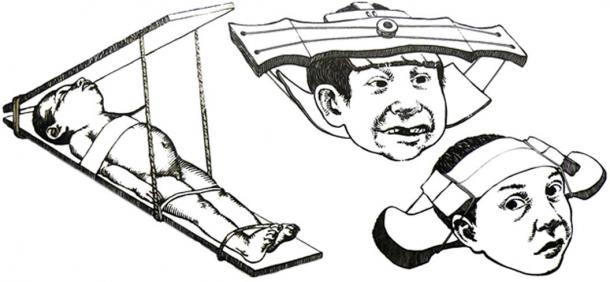
Example of methods used by the Mayan people to shape a kid's head. ( Public Domain )
The cradle caput boarding technique would create an inclination from the eyebrows up to the crown. A raised ridge would also be present from ear-to-ear following this practice. Essentially, the indication of a flat caput not simply implied a higher condition (and maybe intelligence or spiritual elevation) but it was besides intended to reinforce social hierarchy for the Chinookans. In their culture, people with circular heads could be, and often were, enslaved - or at to the lowest degree looked upon with disdain. Thus, high-standing mothers were expected to perform this procedure to show that they cared for and did not fail their children – like about mothers, they wanted them to be accustomed by their peers.
- Elongated Skulls in utero: A Adieu to the Artificial Cranial Deformation Epitome?
- New study reveal origins of elongated skulls in the Carpathian Bowl
- The World-broad Mysterious Phenomena Of Elongated Skulls

Painting by Paul Kane, showing a Chinookan kid in the process of having its head flattened, and an adult subsequently the process. ( Public Domain )
Hind Bounden in Other Cultures
The Chinookan tribe were not the only people to participate in the performance of artificial cranial deformation. A like ritual was performed amidst the Maya people, equally they believed a flat, longer caput was one of the more desirable traits to possess. Farther, according to ancient written sources—the Classical Greek author Hippocrates in particular—the practise was performed equally far back as 400 BC, and known by other cultures around the world.
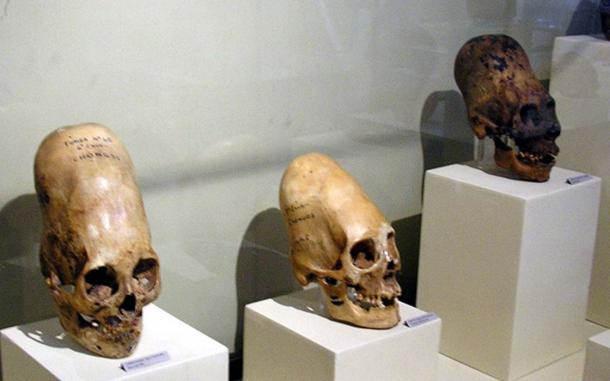
Paracas skulls. ( Public Domain )
When these records are combined with archaeological information from locations such every bit Shanidar Cavern in Republic of iraq, this ritual appears to go every bit far back as the 9th millennium BC—though the actual ritualistic/societal purpose of the practise among Proto-Neolithic Homo sapiens is unknown.
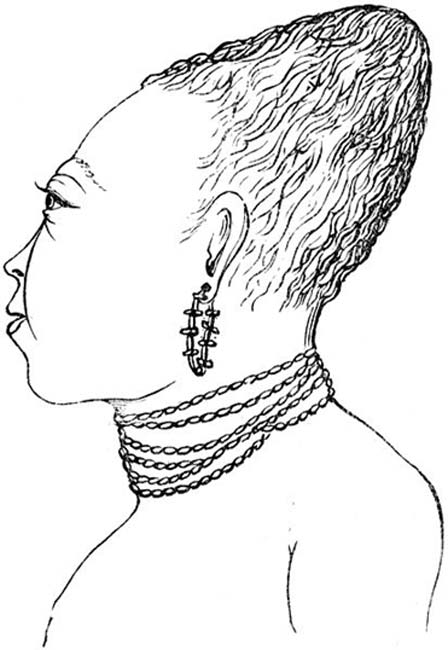
'Apartment headed Indian child'. (1880) ( Public Domain )
The Forgotten Story of the Chinookan Tribe
According to scholars Robert Boyd, Kenneth Ames, and Tony Johnson in their book "Chinookan Peoples of the Lower Columbia", the Chinookan people have been living on the lower portion of the Columbia in modern day Oregon for thousands of years—over 10,000 years to be a bit more precise. The English arrived in the belatedly 1700s, and men such as Lt. William R. Broughton (18th century) and Meriwether Lewis and William Clark (19th century) recorded the Chinookan civilization through their "white-man" eyes. The Chinookans were described every bit sedentary people living in "large, cedar plan houses", with about "25% of the surface area's population" enslaved by the elite and more than powerful commoners."
- Mummified Head of Newborn Baby with Extremely Elongated Skull Found in Peru
- Bizarre Alien-Like Skull Unearthed in Korea was Naturally Formed
- The 13 Alien-Like Skulls Found in Mexico
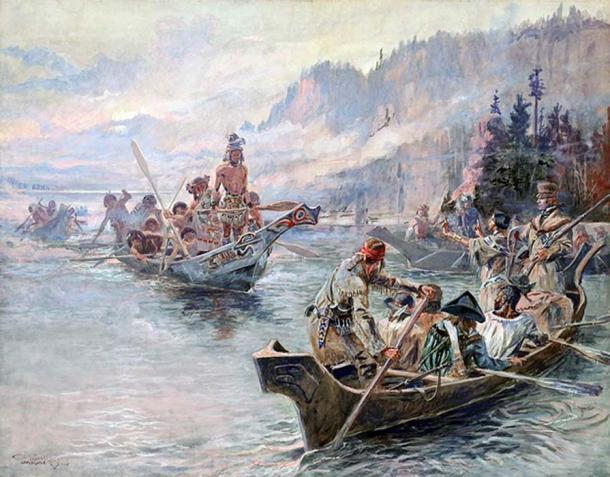
Chinook people see the Corps of Discovery on the Lower Columbia, October 1805. ( Public Domain )
The tribe was not recognized past the United states government until 2001, likely why they are one of the lesser known Native American cultures. Further, the following twelvemonth, when George W. Bush took presidency after Neb Clinton, this recognition was revoked. Therefore, the Chinookan tribe is not widely known or studied in The states history courses.
Superlative image: Chinook kid undergoing process of flattening the head. ( Public Domain )
Past Ryan Stone
Bibliography
Boyd, Robert, Kenneth Ames and Tony Johnson (eds.) Chinookan Peoples of the Lower Columbia. University of Washington Press: WA, 2013.
Smith, Cameron. "Chinookan Culture." The Virtual Meier Site. Accessed January 20, 2017. http://web.pdx.edu/~b5cs/virtualmeier/society.html
Wilson, Katie. "Recognition move by Oregon tribe stirs Chinook concerns". Chinook Observer. 2014. Accessed Jan twenty, 2017. http://world wide web.chinookobserver.com/co/news/20141007/recognition-move-by-oregon-tribe-stirs-chinook-concerns
Why Did Natives Do Head Binding to Babies
Source: https://www.ancient-origins.net/history-ancient-traditions/why-did-parents-chinookan-tribe-perform-cranial-deformation-their-babies-021218
0 Response to "Why Did Natives Do Head Binding to Babies"
Post a Comment